Sunday, August 5, 2012

Romeo and Juliet

Bibliographic Information: Shakespeare, W.  (2011).  Romeo and Juliet (The Folger Shakespeare library). New York: Simon & Schuster Paperbacks.
ISBN:
978-1451621709

Plot Summary: The fair city of Verona has been long terrorized by the ongoing feud between the Capulet and Montague families. The play begins with another scene of violence as servants of the Montague and Capulet families come head to head in yet another scuffle. Sick of the constant violence, the Prince vows to put the next violator to death.  


Elsewhere Benvolio, a cousin of the Montagues, runs into Romeo and asks him why he is so depressed. Romeo finally shares that she is in love with a girl named Rosaline that does not share his feelings. Both Benvolio and Romeo come across a Capulet servant with invitations to a Capulet feast. Benvolio then talks Romeo into going to the feast of their enemies, in order to get over Rosaline. Romeo at first refuses but then agrees.

Meanwhile, Juliet's father is arranging a big ball in which Paris will propose to his daughter (even though she is only 13). Juliet's father has decided that she must become engaged but will hold off on actually marrying her off for another two years.  It is during this feast that Romeo lays eyes upon Juliet, forgetting all about Rosaline. Romeo, at the time, does not realize that Juliet is a Capulet and pursues her.  It is not until Romeo has departed that they both realize the truth about each other's lineage. Romeo, unable to leave, returns and exchanges love vows with Juliet quickly complicating their lives

These vows set a whole mess of events into motion, in which the two fair lovers are secretly married, but cannot be together due to a grievous mistake by Romeo. The story crescendo's in an irreversible miscommunication that seals the fate of both Romeo and Juliet. At the end, both the Capulet and Montague family realize too late that they must change their warring ways or risk having no future at all.

Critical Evaluation: William Shakespeare's Romeo and Juliet plays on the central theme of "only fools rush in."  Every character can be seen making decisions without ever thinking through the consequences from the first scene where the Capulet and Montague servants are seen fighting for the sake of the feud until the ending scene, where Romeo makes his tragic decision without thinking of its permanent consequences. The entire city of Verona is overwrought by badly made decisions that force a series of events that end terribly.

Juliet's downfall can also be attributed to both her young age and also to her father's need to see her carefully squared away in a planned marriage. His direct, and thoughtless, actions force Juliet to search for an exit out- an exit that Romeo offers. Juliet, in this way, may have confused the sense of relief and happiness for new love for Romeo. She may have accepted Romeo's offer because to her, anything was better than being forced into a marriage with Paris. Similarly, Romeo can be seen making questionable decisions as he almost instantly forgets about Rosaline, the girl he previously spent so much time obsessing over. Overall, Shakespeare did not give a single character in
Romeo and Juliet the ability to reason and carefully decide what is best. Instead Shakespeare created a world of chaos, in which everything depends on hasty terrible decision after terrible decision.

Reader’s Annotation:
Two star crossed loves risk everything to be together, even life.
 
Information About the Author: Experts speculate that William Shakespeare was born circa April 23, 1564 in Stratford-upon-Avon, due to his baptism being on April 26, 1564 (biography.com, 2012). Though his plays are popular throughout the whole world not much is known about his personal life (biography.com, 2012). Shakespeare came from a family of six children, being third eldest (biography.com, 2012). No one knows whether or not Shakespeare was educated as a child, some even question if he ever existed (biography.com, 2012).

At the age of 18, Shakespeare married 26 year old Anne Hathaway on November 28, 1582 (biography.com, 2012). They had their first child shortly thereafter and twins 2 years later, only two of these children lived past childhood (biography.com, 2012). Many are unclear about what occurred in the seven years after the twins were born and call these the "lost years" (biography.com, 2012). Shakespeare then appeared on London's theatrical scene in the 1590's (biography.com, 2012). By 1597, Shakespeare had established himself having written 17 of the 35 plays he is known for (biography.com, 2012). By 1599, Shakespeare and a business partner had built the popular theater, the Globe (biography.com, 2012). Shakespeare is said to have died on his birthday (April 23) in 1616.

Shakespeare also wrote the plays (in no particular order): A Midsummer's Night Dream, Merchant of Venice, Henry IV (Part I and II), As You Like It, The Taming of the Shrew, and many others (biography.com, 2012).


Romeo and Juliet - Animated Summary

Genre: Historical, Romance
 

Subgenre:
  Drama
 
Curriculum Ties: Could tie into a lesson on Shakespearean plays and classic literature.

Booktalking Ideas:


Reading Level/Interest Age: YA (Follett's Titlewave, 2012)

Challenge Issues: Does contain violence, sexual themes, and suicide. I would use the following items to defend this book if it was challenged:

1) Refer to Library Bill of Rights, see items: I, II, and III (http://www.ala.org/advocacy/intfreedom/librarybill).
2) Refer to San Diego Public Library collection policy - (http://www.sandiego.gov/public-library/about-the-library/freedom.shtml).  Original site: The American Library Association (ALA) Freedom to Read/View Statement (http://www.ala.org/offices/oif/statementspols/ftrstatement/freedomreadstatement).
3) Refer to California School Library Association (CSLA), Model School Library Standards - September 2010 (http://www.csla.net/index.php/publications/school-library-standards). PDF: (http://www.cde.ca.gov/be/st/ss/documents/librarystandards.pdf).
4) Refer t0 American Association for School, Librarians Standards for the 21st Century Learner (http://www.ala.org/aasl/sites/ala.org.aasl/files/content/guidelinesandstandards/learningstandards/AASL_Learning_Standards_2007.pdf)
5) Contact Office of Intellectual Freedom for any further support, 800-545-2433, ext. 4223 or oif@ala.org.
6) Refer to legitimate book reviews, such as: School Library Journal, Booklist, Kirkus Reviews, Horn Book and others; found on either Academic Search Premier, Follett's TITLEWAVE, or Amazon.com.

Why did you include this play in the titles you selected?:
I included Romeo and Juliet in my collection because I thought it was crucial to include at least one of William Shakespeare's classic plays. I also think teens will be able to identify with some of the play's themes of love, heartbreak, and the inability to move on.

Reference Page:


biography.com.  (2012).  William Shakespeare's biography. Retrieved August 5, 2012 from http://www.biography.com/people/william-shakespeare-9480323


Follett's Titlewave.  (2012).  Romeo and Juliet.  Retrieved August 5, 2012 from Follett's Titlewave iPhone app. 

The Great Gatsby


Bibliographic Information: Fitzderald, F. S.  (1925).  The great Gatsby.  New York: Scribner.
 ISBN: 978-0-7432-7356-5 
 
Plot Summary: Set in the roaring 20's, or Jazz Age, The Great Gatsby is a critical look at society's lack of values and finicky nature. Nick Carraway, the narrator, has recently moved to New York (Long Island, specifically) to pursue a fast life of business. Nick moves into the West Egg neighborhood, which is inhabited by people with new money. West Egg happens to be across the water from East Egg, where those with old money and high social standing live; amongst them, Nick's cousin, Daisy Buchannan. Nick soon learns that he is living next to the mysterious Jay Gatsby (originally James Gatz) a man of new money, with a questionable past, that regularly throws lavish parties for the surrounding rich socialites. Nick also learns that fidelity is a lost value amongst the rich as he witnesses several relationships fall apart around him. Upon becoming closer to Gatsby, Nick discovers the true reason behind Gatsby's parties as Gatsby asks Nick to arrange a meeting between Gatsby and Daisy (a love from his past). Nick, though a non-judgmental narrator, can no longer ignore the true nature of East and West Egg as events culminate into lies, infidelity, murder, and careless destruction of the lives of others.

Critical Evaluation: "Gatsby believed in the green light, the orgastic future that year by year recedes before us. It eluded us then, but that’s no matter—tomorrow we will run faster, stretch out our arms farther. . . . And then one fine morning—

So we beat on, boats against the current, borne back ceaselessly into the past" (p. 180).


Fitzgerald's closing quote resonates a theme of unrealized dreams that is played within most characters in The Great Gatsby. Each character runs towards the distant future thinking it will provide them bigger and better things ("the illusive green light" on the other dock) but find that as they run towards their ideal futures that they get seemingly farther and farther away. This can be seen in Nick's move to New York where he is both attracted and repelled by the culture of high rollers and excitement. Being shocked and disheartened by the realities of Long Island, Nick eventually finds that the future he wants is actually in his past and returns to the Midwest.  This can also be seen in Daisy, who despite being in love with Gatsby, marries Tom Buchanan in order to ensure that her future will be comfortable and taken care of. Daisy, can always be seen on the cusp of changing her mind and returning to a past life, until terrible events permanently force her into a life with Tom Buchanan. And, lastly, it can be seen in the main character, Jay Gatsby (James Gatz) who has changed his entire world in order to chase the promise of a possible future with Daisy. Gastby completely reconstructs himself, becoming wealthy (even if illegally) in order to please and attract the woman he believes to be the love of his life, Daisy. Unfortunately, Gatsby, like the others, finds that although he kept beating towards the future that he thought could be possible, that all he was really seeing was a reflection of a past (when Daisy truly loved him) that he can never return to. The green light, in this sense, becomes an ephemeral echo of not a future but an idyllic past that neither Gatsby, or anyone else, can ever return to.


Reader’s Annotation:
Nick finds that love makes fools of us all.
 
Information About the Author: Francis Scott Key Fitzgerald was named after a distant cousin, Francis Scott Key who wrote the "Star Spangled Banner" (biography.com, 2012). Fitzgerald was born on September 24, 1896 in St. Paul, Minnesota (biography.com, 2012). Fitzgerald grew up writing for school publications, but eventually enlisted to fight in WWI. It was during this time that he met his future wife, 18 year old Zelda Sayre (biography.com, 2012). It is said that Zelda was inspiration for the character, Daisy, in The Great Gatsby (biography.com, 2012). Fitzgerald received some critical acclaim for This Side of Paradise, his first novel, which instantly transformed his life (biography.com, 2012). Unfortunately, this also kept critics from taking Fitzgerald seriously due to his partying ways (biography.com, 2012). Fitzgerald eventually moved to France in search of more inspiration (biography.com, 2012). Fitzgerald wrote The Great Gatsby while in France, but also turned more and more to alcohol becoming an alcoholic (biography.com, 2012). Fitzgerald's wife, Zelda, also suffered a series of breakdowns which made them move from the United States to France on separate occasions. She was ultimately institutionalized in Baltimore, Maryland (biography.com, 2012).

Fitzgerald died from a heart attack at the age off 44 in 1940 (biography.com, 2012). Fitzgerald is known for several novels and stories: Tender is the Night, "The Curious Case of Benjamin Button," and several others (biography.com, 2012). Fitzgerald left one last unfinished novel at the time of his death, The Love of the Last Tycoon (biography.com, 2012).   


F. Scott Fitzgerald Biography Video

Genre:
Historical, Romance

Subgenre:
Roaring 20's
 
Curriculum Ties:  Can tie into lessons on the 18th amendment and the 1920's. 

Booktalking Ideas:
1). What is Fitzgerald saying about the American Dream in The Great Gatsby?
2). Is Daisy really the vain character she is written to be? Is there anything below the surface?

Reading Level/Interest Age: Lexile Reading Level: 1070/YA (Follett's Titlewave, 2012) 

Challenge Issues: This book includes references, to alcohol, some sexual themes, and murder. I would use the following items to defend this book if it was every challenged:

1) Refer to Library Bill of Rights, see items: I, II, and III (http://www.ala.org/advocacy/intfreedom/librarybill).
2) Refer to San Diego Public Library collection policy - (http://www.sandiego.gov/public-library/about-the-library/freedom.shtml).  Original site: The American Library Association (ALA) Freedom to Read/View Statement (http://www.ala.org/offices/oif/statementspols/ftrstatement/freedomreadstatement).
3) Refer to California School Library Association (CSLA), Model School Library Standards - September 2010 (http://www.csla.net/index.php/publications/school-library-standards). PDF: (http://www.cde.ca.gov/be/st/ss/documents/librarystandards.pdf).
4) Refer t0 American Association for School, Librarians Standards for the 21st Century Learner (http://www.ala.org/aasl/sites/ala.org.aasl/files/content/guidelinesandstandards/learningstandards/AASL_Learning_Standards_2007.pdf)
5) Contact Office of Intellectual Freedom for any further support, 800-545-2433, ext. 4223 or oif@ala.org.
6) Refer to legitimate book reviews, such as: School Library Journal, Booklist, Kirkus Reviews, Horn Book and others; found on either Academic Search Premier, Follett's TITLEWAVE, or Amazon.com.

Why did you include this book in the titles you selected?:
The Great Gatsby has been named by critics one of the great American novels of the 20th century. This book exposes teens to both historical and literary implications of a very important time in American history. I wanted my collection to include at least a few classical pieces of literature.

Reference Page:


biography.com.  (2012).  F. Scott Fitzgerald biography. Retrieved August 5, 2012 from http://www.biography.com/people/f-scott-fitzgerald-9296261?page=1

Follett's Titlewave.  (2012).  The great Gatsby.  Retrieved August 5, 2012 from Follett's Titlewave iPhone app. 

cover art: http://hemingwayheroine.blogspot.com/2012/06/great-gatsby-f-scott-fitzgerald.html

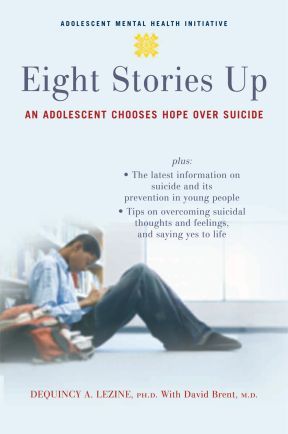
Eight Stories Up: An Adolescent Chooses Hope Over Suicide

Bibliographic Information: Lezine, D. A. & Brent, D.  (2008).  Eight stories up: An adolescent chooses hope over suicide. Oxford: Oxford University Press.
ISBN:  978-0-19-532557-7


Plot Summary: DeQuincy A. Lezine, Ph. D, was once plagued by thoughts of suicide and depression as a young adult. After several failed attempts to end his life, Lezine was able to find the help he needed to diagnose the root of his troubles and to finally make the right changes. After building a life in suicide prevention, Lezine decided to write this book for teens who may be struggling with the same problems he once faced. Lezine writes this book with a simple and direct narrative and truly attempts to reach out to his main audience of young adults and teens. Lezine breaks this book down into six distinct parts that describe each level of his journey:
Letter to the Reader in Crisis, The Background Story (where and why it began), Inside the Suicidal Mind (understanding what is happening), Getting Help, Recovery, and Finding the Phoenix: Where I Am Today. Lezine also provides a frequently asked questions section, a glossary of relevant terms, and a resource section full off important suicide prevention services and hotlines. Lezine has crafted this book as an open and sincere suicide prevention resource that teens can rely on when they have nowhere else to turn. 

Critical Evaluation: Lezine draws from his own experience to reach across and help a new generation of young adults who are struggling with the same paralyzing and destructive disorder that once plagued his own life. His opening "Letter to the Reader in Crisis" reiterates the fact that suicide is one single choice amongst many in terms of how to deal with the pain of depression. Lezine believes, that like any other big decision, that suicide always deserves a second opinion. For this reason, Lezine believes that it is important to not make brash decisions when under great pain and to always reach out, whether it be to a friend, a mentor, or even to a national suicide prevention hotline (like National Suicide Prevention Hotline 1-800-273-TALK [8255]). The overall message Lezine wants to impart is this: you owe it to yourself to examine every option before deciding on something as permanent and irreversible as suicide.


Reader’s Annotation:
Suicide is a silent killer that must be studied and discussed in order to be stopped. Suicide is not the only option. 
 
Information About the Author: DeQuincy Lezine, Ph. D was inspired to write this work due to his own brush with suicide freshman year of college (dmh.mo.gov, 2012). Lezine was fortunate to survive three separate suicide attempts and receive the help he needed to move on. He then began the first Suicide Prevention Action network at Brown University (BSPAN) (dmh.mo.gov, 2012).  Lezine has been a very active advocate of suicide prevention since then (dmh.mo.gov, 2012).

Lezine completed his doctoral training in clinical psychology from UCLA and a postdoctoral fellowship at the University of Rochester (dmh.mo.gov, 2012). Lezine's research emphasis has been on suicide prevention and continues to advocate for the survivors of suicide through a variety of different suicide prevention techniques (dmh.mo.gov, 2012).

Genre:
Nonfiction

 
Subgenre: Suicide Prevention
 
Curriculum Ties: Can tie into a health lesson on suicide prevention and detection.

Booktalking Ideas:

1). How can suicide prevention resources be presented to teens in a non-threatening and helpful manner?
2). How many suicide prevention resources are you familiar with?
3). What suicide prevention resources are offered at your school or work place?

Reading Level/Interest Age: YA

Challenge Issues: Discusses suicide and its effects in detail. I would used the following items to defend this book if it was ever challenged:

1) Refer to Library Bill of Rights, see items: I, II, and III (http://www.ala.org/advocacy/intfreedom/librarybill).
2) Refer to San Diego Public Library collection policy - (http://www.sandiego.gov/public-library/about-the-library/freedom.shtml).  Original site: The American Library Association (ALA) Freedom to Read/View Statement (http://www.ala.org/offices/oif/statementspols/ftrstatement/freedomreadstatement).
3) Refer to California School Library Association (CSLA), Model School Library Standards - September 2010 (http://www.csla.net/index.php/publications/school-library-standards). PDF: (http://www.cde.ca.gov/be/st/ss/documents/librarystandards.pdf).
4) Refer t0 American Association for School, Librarians Standards for the 21st Century Learner (http://www.ala.org/aasl/sites/ala.org.aasl/files/content/guidelinesandstandards/learningstandards/AASL_Learning_Standards_2007.pdf)
5) Contact Office of Intellectual Freedom for any further support, 800-545-2433, ext. 4223 or oif@ala.org.
6) Refer to legitimate book reviews, such as: School Library Journal, Booklist, Kirkus Reviews, Horn Book and others; found on either Academic Search Premier, Follett's TITLEWAVE, or Amazon.com.

Why did you include this book in the titles you selected?:
Suicide is a very serious aspect of teen life that must be discussed and attacked head on in order for it to be stopped. Lezine writes a very sincere book on his own experiences that offer teens a safe haven where they can closely study someone else's experience as well as their own. This book is important in helping teens understand and overcome suicidal tendencies or tragedies.

Reference Page:


dmh.mo.gov.  (2012).   2010 suicide prevention conference: Featured speakers.  Retrieved August 5, 2012 from http://dmh.mo.gov/mentalillness/suicide/conference/2010/index.htm

Ender's Shadow: Battle School

Bibliographic Information: Card, O. S (Creator), Carey, M (Script) & Fiumara, S. (Illustrator).  (2009).  Ender's Shadow: Battle School.  New York: Marvel Comics. ISBN: 978-0-7851-3596-8

Plot Summary:
Ender's Shadow: Battle School tells the story of Bean, a young abandoned child with a mysterious past who must survive in a war torn Rotterdam amongst the masses of homeless children. In a twist of fate, in which Bean witnesses the death of the beloved street gang leader, Poke, Bean fears for his life and is taken into the care of Sister Carlotta. Bean begins to spike the curiosity of Sister Carlotta who believes him to be special and unusual. Sister Carlotta then finds out how special Bean is when she administers a series of tests that prove his aptitude and mental understanding to be off of the charts. Sister Carlotta works hard to nominate Bean for Battle School, a contingent that is overseen by Colonel Graff. Colonel Graff is not convinced that Bean is special but extends an invitation to his school anyways. Bean is then immersed in Battle School where he carefully watches the world around him, always one step ahead of the rest.

Critical Evaluation: Based on Orson Scott Card's, Ender's Shadow novel, Ender's Shadow: Battle School takes a closer look at the character of Bean. Although Ender's Shadow: Battle School can be read as a stand alone graphic novel, many of the details of this story come from the novels. Sebastian Fiumara, brings this story to life with large multi-frame illustrations of Bean's life
and world. The use of different angles and perspectives allow the reader to fall into Bean's story, giving the book an almost voyeuristic feel. Through Fiumara rich illustrations the reader is also able to witness the development of Bean, as he carefully plots his every move from the beginning of the story until the end. The reader almost forgets that Bean is really a small child ranging in age between 4 and 7 years of age because of his confrontational attitude. Bean is also constantly illustrated in rigid unblinking stances that communicate his lack of fear and his calculating and cool exterior. Fiumara's carefully picked palette of subdued colors really bring a sharp contrast to the characters and hectic quality of the war torn Rotterdam world.

Reader’s Annotation:
The world continues to exist in disrepair forcing children to fight till the death in order to survive another day.
 
Information About the Author: Orson Scott Card was born in Richland, Washington in 1951 to a devout Mormon family (Card, 2012). Hi great grandfather, Charles Ora Card, was married to Zina Young Card daughter of Brigham Young, a very influential Mormon (Card, 2012). Card spent much of his childhood moving around but eventually ended up in Salt Lake City, Utah where he received a Presidential Scholarship to attend Brigham Young University  where he enrolled as an archeology major (Card, 2012). All throughout his childhood, Card was always interested in theater and eventually decided to change majors to become a theater major (Card, 2012). He ended up leaving his university a few credits short of graduating in order to go on his two year Mormon mission in Brazil (Card, 2012). Card eventually returned, finished his college degree, and proceeded to start a theater company that failed (Card, 2012). Card got married in 1977 to a daughter of a Brigham Young professor, Kristine Allen (Card, 2012). Card and his wife began a family, of which only three survived. 

Card has spent most of his career writing for several different Mormon publications in order to support his family (Card, 2012). He eventually wrote Ender's Game and Ender's Shadow in the 1990's which both slowly amassed a cult following. He currently lives in Greensboro, North Carolina with his wife and family (Card, 2012).

Genre:
Science Fiction, Mystery, Horror, and Suspense, Adventure

Subgenre:
Dystopian, Alternate Worlds, Militaristic, Space Opera and Galactic Empires
 
Curriculum Ties: N/A

Booktalking Ideas:

1). Why does Bean tell Poke to kill Achilles?
2). Why doesn't Bean play the computer games each "launchy" has been given?

Reading Level/Interest Age: Grades 10-12 (Karp, 2012)  

Challenge Issues: Includes themes of graphic violence and blood. I would use the following items to defend this book if it was challenged:

1) Refer to Library Bill of Rights, see items: I, II, and III (http://www.ala.org/advocacy/intfreedom/librarybill).
2) Refer to San Diego Public Library collection policy - (http://www.sandiego.gov/public-library/about-the-library/freedom.shtml).  Original site: The American Library Association (ALA) Freedom to Read/View Statement (http://www.ala.org/offices/oif/statementspols/ftrstatement/freedomreadstatement).
3) Refer to California School Library Association (CSLA), Model School Library Standards - September 2010 (http://www.csla.net/index.php/publications/school-library-standards). PDF: (http://www.cde.ca.gov/be/st/ss/documents/librarystandards.pdf).
4) Refer t0 American Association for School, Librarians Standards for the 21st Century Learner (http://www.ala.org/aasl/sites/ala.org.aasl/files/content/guidelinesandstandards/learningstandards/AASL_Learning_Standards_2007.pdf)
5) Contact Office of Intellectual Freedom for any further support, 800-545-2433, ext. 4223 or oif@ala.org.
6) Refer to legitimate book reviews, such as: School Library Journal, Booklist, Kirkus Reviews, Horn Book and others; found on either Academic Search Premier, Follett's TITLEWAVE, or Amazon.com.

Why did you include this graphic novel in the titles you selected?:
I picked this graphic novel because it is a great addition to my collection. This graphic novel will interest reluctant readers who love science fiction stories. It may also motivate students to read Orson Scott Card's novels which will help further strengthen reading skills.


Reference Page: 


Karp, J.  (2012).  Booklist reviewRetrieved August 5, 2012 from http://www.amazon.com/Enders-Shadow-Battle-School-Game/dp/B005DI819Q/ref=sr_1_1?ie=UTF8&qid=1344184718&sr=8-1&keywords=enders+shadow%3A+battle+school

Cara, O. S.  (2012).  Who is Orson Scott Card?.  Retrieved August 5, 2012 from http://www.hatrack.com/osc/about-more.shtml

cover art: http://www.comicrelated.com/forums/lofiversion/index.php?t5021.html

Saturday, August 4, 2012

AlternaCrafts: 20+ Hi-Style Lo-Budget Projects to Make

Bibliographic Information: Vitkus, J.  (2005).  AlternaCrafts: 20+ Hi-style lo-Budget projects to make.  New York : Stewart, Tabori & Chang.
ISBN: 978-1-58479-465-1

Plot Summary: AlternaCrafts: 20+ Hi-Style Lo-Budget Projects to Make offers independently minded teens fun and new exciting craft ideas that they can complete with items they already own. This book will teach teens how to transform old items (unused jeans, tshirts, bottle caps, etc.) into fun new items that are ready for every day wear and use (jean skirt, tshirt run, bottle cap pendants and magnets etc.). The book is broken down into items to wear, items to make for the home, and gifts. Teens will be attracted by the bright pictures and simplified tutorials with plenty of explanations and definitions.

Critical Evaluation: N/A

Reader’s Annotation:
Time to get crafty with these fun modern craft ideas.

Information About the Author: Jessica Vitkus received her B.A in English from Columbia University in 1988 (linkedin.com, 2012). She currently works for Animal Planet. She has previously worked on OWN (Oprah Winfrey Network), MTV (a variety of shows), "Who Wants to be a Millionaire?," The Daily Show, Martha Stewart, and many others (linkedin.com, 2012). She may have received inspiration to write AlternaCrafts: 20+ Hi-Style Lo-Budget Projects to Make after working as a magazine writer/producer/crafter with Martha Stewart Living Omnimedia.


AlternaCrafts: 20+ Hi-Style Lo-Budget Projects to Make Book Preview

Genre:
Nonfiction

Subgenre:
Arts & Crafts
 
Curriculum Ties: Could tie into a craft day or art class.

Booktalking Ideas:
N/A

Reading Level/Interest Age: YA (Follett's Titlewave, 2012)

Challenge Issues: No challenge issues.

1) Refer to Library Bill of Rights, see items: I, II, and III (http://www.ala.org/advocacy/intfreedom/librarybill).
2) Refer to San Diego Public Library collection policy - (http://www.sandiego.gov/public-library/about-the-library/freedom.shtml).  Original site: The American Library Association (ALA) Freedom to Read/View Statement (http://www.ala.org/offices/oif/statementspols/ftrstatement/freedomreadstatement).
3) Refer to California School Library Association (CSLA), Model School Library Standards - September 2010 (http://www.csla.net/index.php/publications/school-library-standards). PDF: (http://www.cde.ca.gov/be/st/ss/documents/librarystandards.pdf).
4) Refer t0 American Association for School, Librarians Standards for the 21st Century Learner (http://www.ala.org/aasl/sites/ala.org.aasl/files/content/guidelinesandstandards/learningstandards/AASL_Learning_Standards_2007.pdf)
5) Contact Office of Intellectual Freedom for any further support, 800-545-2433, ext. 4223 or oif@ala.org.
6) Refer to legitimate book reviews, such as: School Library Journal, Booklist, Kirkus Reviews, Horn Book and others; found on either Academic Search Premier, Follett's TITLEWAVE, or Amazon.com.

Why did you include this book in the titles you selected?:
I included this book because I think it is important to provide teens with an outlet for artistic expression. Many teens are participating in DIY and crafting projects recently due to the great success of the social media site, Pinterest.

Reference Page:


Follett's Titlewave.  (2012).   AlternaCrafts: 20+ hi-style lo-budget projects to make.  Retrieved August 4, 2012 from Follett's Titlewave App. 

 
linkedin.com.  (2012).  Jessica Vitkus.  Retrieved August 4, 2012 from http://www.linkedin.com/pub/jessica-vitkus/5/ba/4a9

Where's My Stuff?: The Ultimate Teen Organizing Guide

Bibliographic Information: Moss S., Schwartz, L. & Wertz, M.  (2007). Where's my stuff?: The ultimate teen organizing guide. San Francisco: Zest Books.
ISBN: 978-0-9819733-7-1

Plot Summary: Teens live active lives that require a lot of careful planning or organization or else things can fall apart. Moss, Schwartz, and Wertz have written this book for all the teens that may need a little extra help figuring out how to get things together. This book starts off by explaining why being organized is important, then provides a quiz so that the reader can determine what kind of organizational help they need, and make the following sections more useful. This organizational guide includes sections on how to organize school stuff, the room, activities and time, and even provides visual examples of how to organize each item. All these chapters are geared towards making life easier for busy teens. Even parents can benefit from some of the tips and suggestions that are offered throughout the chapters of this book.

Critical Evaluation: N/A

Reader’s Annotation:
Being organized means more time for fun, relaxation, and getting the right stuff done!
 
Information About the Author: Samantha Moss has participated in many projects over the last ten years as both writer and editor (Moss, 2012). Some of her projects include: Pottery Barn Flowers and ten volumes of the Pottery Barn Design Library (Moss, 2012). She currently lives in Oakland, California with her husband, Boyd, and their dog, Belly (Moss, 2012). 

Lesley Schwartz graduated from both Wellesley College and Mills College and currently lives in San Francisco, California
(Schwartz, 2007). Schwartz has a variety of professional skills: including teen organizer, academic coach, and tutor (Schwartz, 2007). She has also worked as a teacher in the past (Schwartz, 2007). Schwartz was the primary consultant for Where's My Stuff?: The Ultimate Teen Organizing Guide (Schwartz, 2007).
 
Michael Wertz is a commercial artist that has been contracted on a number of jobs (Wertz, 2012). Wertz designs art pieces that begin as pencil drawings and end as bold digital collages, mono prints, and screen prints (Wertz, 2012). Wertz has had projects with over 35 large organizations, such as: Pottery Barn, Scholastic Inc., Cisco, Hewlett-Packard, and many more (Wertz, 2012). Wertz does work for all age ranges and isn't solely dedicated to children's projects (Wertz, 2012).

Genre:
Nonfiction

 
Subgenre:
Personal Organization
 
Curriculum Ties: Could tie into a lesson on personal time and space management.

Booktalking Ideas:
N/A

Reading Level/Interest Age: YA (Follett's Titlewave, 2012)

Challenge Issues: No challenge issues.

1) Refer to Library Bill of Rights, see items: I, II, and III (http://www.ala.org/advocacy/intfreedom/librarybill).
2) Refer to San Diego Public Library collection policy - (http://www.sandiego.gov/public-library/about-the-library/freedom.shtml).  Original site: The American Library Association (ALA) Freedom to Read/View Statement (http://www.ala.org/offices/oif/statementspols/ftrstatement/freedomreadstatement).
3) Refer to California School Library Association (CSLA), Model School Library Standards - September 2010 (http://www.csla.net/index.php/publications/school-library-standards). PDF: (http://www.cde.ca.gov/be/st/ss/documents/librarystandards.pdf).
4) Refer t0 American Association for School, Librarians Standards for the 21st Century Learner (http://www.ala.org/aasl/sites/ala.org.aasl/files/content/guidelinesandstandards/learningstandards/AASL_Learning_Standards_2007.pdf)
5) Contact Office of Intellectual Freedom for any further support, 800-545-2433, ext. 4223 or oif@ala.org.
6) Refer to legitimate book reviews, such as: School Library Journal, Booklist, Kirkus Reviews, Horn Book and others; found on either Academic Search Premier, Follett's TITLEWAVE, or Amazon.com.

Why did you include this book in the titles you selected?:
As teens become older they will be expected to be able to manage their own lives. Often teens cannot live up to this expectation because they are not equipped with the right skills. I included this book in my collection because I believe being organized and on time is key in anyone's success. This book will help teens develop the skills they need to stay on top of their hectic schedules.

Reference Page:

Follett's Titlewave.  (2012).  Where's my stuff?: The ultimate teen organizing guide. Retrieved August 4, 2012 from Follett's Titlewave App.

Moss
, S.  (2012).  Bio. Retrieved August 4, 2012 from http://samanthamoss.com/bio.html

Schwartz, L.  (2007).  Biography.  Retrieved August 4, 2012 from http://www.lesleyschwartz.com/bio.html

Wertz, M.  (2012).  About.  Retrieved August 4, 2012 from http://wertzateria.com/about.html


cover art: http://technorati.com/lifestyle/family/article/teenlit-wheres-my-stuff-is-a/

The Official SAT Study Guide, Second Edition

Bibliographic Information: The College Board.  (2009).  The official SAT study guide, second edition.  New York: CollegeBoard
ISBN: 978-087-447-852-5

Plot Summary: This updated study guide is jam packed with tips and tricks for any student to improve their overall SAT score. This study guide is broken down into five sections that are each dedicated to analyzing one particular part of the SAT exam. Part I features an introduction and description of the SAT's. Part II includes a close look at the critical reading section of the SAT's and focuses on passage-based reading. Part III studies the writing section of the SAT's and reviews the mechanics of proper writing. Part IV is a mathematics section and includes a review on subjects like: numbers and operations, algebra, and several others. The final section Part V, offers ten full practice tests with answer keys that put the already learned lessons, tips, and tricks into play. 

Critical Evaluation: N/A

Reader’s Annotation:
SAT study guides: essential for any high school student's future success!
 
Information About the Publisher: The College Board was originally formed by 12 colleges and universities in 1900 as a way to standardize the process of students being tested and applying to different universities (collegeboard.org, 2012). The College Board was eventually replaced by the SAT's and has been reviewed and reformatted since its inception (collegeboard.org, 2012). Currently CollegeBoard works hard to provide services to children in K-12 all geared towards making the path to college easier (collegeboard.org, 2012).

CollegeBoard interacts with over seven million students and parents, in a 180 countries and territories, and through over 900 colleges and universities
(collegeboard.org, 2012). CollegeBoard believes in making college possible through financial, academic, and mentorship support (collegeboard.org, 2012).

Genre: 
Nonfiction

Subgenre:
Study Guide
 
Curriculum Ties: Could tie into SAT prep courses offered in school.

Booktalking Ideas:
N/A

Reading Level/Interest Age: YA (Follett's Titlewave, 2012)

Challenge Issues: No challenge issues

1) Refer to Library Bill of Rights, see items: I, II, and III (http://www.ala.org/advocacy/intfreedom/librarybill).
2) Refer to San Diego Public Library collection policy - (http://www.sandiego.gov/public-library/about-the-library/freedom.shtml).  Original site: The American Library Association (ALA) Freedom to Read/View Statement (http://www.ala.org/offices/oif/statementspols/ftrstatement/freedomreadstatement).
3) Refer to California School Library Association (CSLA), Model School Library Standards - September 2010 (http://www.csla.net/index.php/publications/school-library-standards). PDF: (http://www.cde.ca.gov/be/st/ss/documents/librarystandards.pdf).
4) Refer t0 American Association for School, Librarians Standards for the 21st Century Learner (http://www.ala.org/aasl/sites/ala.org.aasl/files/content/guidelinesandstandards/learningstandards/AASL_Learning_Standards_2007.pdf)
5) Contact Office of Intellectual Freedom for any further support, 800-545-2433, ext. 4223 or oif@ala.org.
6) Refer to legitimate book reviews, such as: School Library Journal, Booklist, Kirkus Reviews, Horn Book and others; found on either Academic Search Premier, Follett's TITLEWAVE, or Amazon.com.

Why did you include this book in the titles you selected?:
I selected this book for the older segment of my age group (17-18, possibly 16). These students are working hard to graduate and will understand the impact of a great score on future plans. Providing study guides for students is a great way to ensure they will succeed.

Reference Page:

collegeboard.org.  (2012).  About us.  Retrieved August 4, 2012 from http://about.collegeboard.org/  

Follett's Titlewave.  (2012).  The official SAT study guide, second edition.  Retrieved August 4, 2012 from Follett's Titlewave App.

 cover art: http://freeebooksearch.net/the-official-sat-study-guide-2nd-edition