Showing posts with label *Books*. Show all posts

Monday, August 6, 2012

Death by Bikini

Bibliographic Information: Gerber, L.  (2008). Death by bikini.  New York: Sleuth. 
ISBN: 978-0329066220-2

Plot Summary: Aphra Connolly had no choice in her father's decision to move them to a remote volcanic island four years earlier. Far from her prior home in South Carolina, Aphra spends her time assisting her father at their beachside resort and swimming in the ocean. Everything suddenly changes when a mysterious family appears on the island, a dead body washes up on the shore, and Aphra realizes that not everyone is what they seem.

Critical Evaluation: The setting, a distant volcanic island, plays a great role in Death by Bikini. The characters are enveloped by elements of the wild ocean, the untamed tropical wilderness, and secluded destinations around the island that carry along the suspense of the plotline. It's this element of the unknown that carries forward the first unsolved murder and adds a sense of abandoned foreboding to the overall storyline. This aspect, along with a climactic thunderhead, function almost like soundtrack cues that indicate to the reader what they should be feeling at that point in the narrative. It is also the surroundings that dictate the mood and state of mind of each of the characters. The "Smith Family," the island celebrities, and even Aphra's father feel like the secluded island may actually function as a haven and act accordingly. Aphra, on the other hand, feels both soothed and imprisoned by the surrounding presence of the ocean and the isolation that it imposes on her life. To Aphra, the ocean symbolizes the many miles between her and her past life in South Carolina; a thought that isn't very comforting. The setting continues to change and develop similarly to each character. The setting in the end may be one of the biggest players of the story; constantly indicating where the plot and characters are going

Reader’s Annotation:
Aphra's island life is suddenly turned upside down by a bikini, the appearance of a secretive family, and dangerous figures that suddenly lurk throughout the island.
 
Information About the Author: Linda Gerber has always had three passions in life: books, writing, and traveling (Gerber: Bio, 2012). Gerber has spent so much traveling that it took her a little longer to graduate college since she was always going somewhere new (Gerber: Bio, 2012). To date she has traveled and/or lived in the following cities and countries: Utah, California, Arizona, Ohio, Michigan, Washington, D. C., Finland, Japan, Europe, Asia, Mexico, Australia, Hawaii, and Micronesia (Gerber: Bio, 2012). Gerber currently lives in Ohio (Gerber: Bio, 2012). A few things Gerber enjoys: sushi, spending time with her family, and classic rock (Gerber: Bio, 2012).

Some other books Linda Gerber has written: Lights, Camera, Cassidy series, Trance, Death by Denim, Death by Latte, The Finnish Line: Students Across the Seven Seas (Gerber: Books, 2012)

To learn more about Linda Gerber visit:  


Genre: Mystery, Horror, and Suspense, Romance, Adventure

Subgenre:
Murder Mystery
 
Curriculum Ties: N/A
 
Booktalking Ideas:

1). Did Aphra's father make the right decision in hiding the letters that Aphra's mother sent her?
2). Is Aphra old enough to understand the importance of keeping secrets?   

Reading Level/Interest Age: Lexile Reading Level: 640/YA (Follett's Titlewave, 2012)

Challenge Issues: Includes murder, violence, and some strong language. I would use the following items to defend this book if it was ever challenged:

1) Refer to Library Bill of Rights, see items: I, II, and III (http://www.ala.org/advocacy/intfreedom/librarybill).
2) Refer to San Diego Public Library collection policy - (http://www.sandiego.gov/public-library/about-the-library/freedom.shtml).  Original site: The American Library Association (ALA) Freedom to Read/View Statement (http://www.ala.org/offices/oif/statementspols/ftrstatement/freedomreadstatement).
3) Refer to California School Library Association (CSLA), Model School Library Standards - September 2010 (http://www.csla.net/index.php/publications/school-library-standards). PDF: (http://www.cde.ca.gov/be/st/ss/documents/librarystandards.pdf).
4) Refer t0 American Association for School, Librarians Standards for the 21st Century Learner (http://www.ala.org/aasl/sites/ala.org.aasl/files/content/guidelinesandstandards/learningstandards/AASL_Learning_Standards_2007.pdf)
5) Contact Office of Intellectual Freedom for any further support, 800-545-2433, ext. 4223 or oif@ala.org.
6) Refer to legitimate book reviews, such as: School Library Journal, Booklist, Kirkus Reviews, Horn Book and others; found on either Academic Search Premier, Follett's TITLEWAVE, or Amazon.com.

Why did you include this book in the titles you selected?:
I included this book because it offers mystery lovers a great case to solve. Teens will also enjoy the 16 year old protagonist, Aphra, as she works to figure out what is going on around the island.

Reference Page:


Follett's Titlewave.  (2012).  Death by bikini. Retrieved August 9, 2012 from the Follett's Titlewave iPhone app.

Gerber, L.  (2012).  Bio.  Retrieved August 9. 2012 from http://lindagerber.com/bio.html
 

Gerber, L.  (2012).  Books.  Retrieved August 9. 2012 from http://lindagerber.com/books.html

Sunday, August 5, 2012

The Only Alien on the Planet

Bibliographic Information: Randle, K. D.  (2009).  The only alien on the planet.  Naperville: Sourcebooks.
ISBN:
978-1-40222-669-4

Plot Summary: Seventeen year old Ginny Christianson would give anything to keep her parents from uprooting her and her three brothers in a move east coast. On top of it all, Ginny's best friend, her older brother Paul, has left for his first year of college; essentially abandoning her. Ginny is soon forced to adapt to things in her new home as she enrolls in the local high school for her senior year. In the process Ginny makes friends with the popular Hally and her new next door neighbor, Caulder. Everything is going great for Ginny until she becomes obsessed with the beautiful anomaly known as "The Alien," or Smitty Tibbs.  Smitty is known as "The Alien" because he hasn't spoken or reacted to the world around him since a traumatic experience at the age of two. Caulder and Ginny make it their mission to pull Smitty into their world, until their actions are met with serious consequences.

Critical Evaluation: One of the biggest themes in
The Only Alien on the Planet is that of  the characters trying to find or establish some sense of "normalcy." Ginny, or Virginia, Christianson, the protagonist of  The Only Alien on the Planet, tells the story from her point of view. Ginny begins her narrative wanting to constantly find the "norm" in her life, the balance that sets her apart from other unbalanced individuals. Ginny's world is shaken when her parents make an unexpected move to the east coast and leave their kids mostly in their own care while they (the parents) work hard to establish their business in the new town. To Ginny this symbolizes a move away from the norm, a fracture in the family unit. Ginny is further forced to reanalyze her standards of what she thinks is "normal" when she meets the beautiful and mysterious figure of Smitty Tibbs. Through Smitty, Ginny begins to understand that "normal" is different for each and every person. This fact forces her to reexamine her own life and really understand just how lucky she really is. Ginny is able to understand that her small discomforts do not take away from the love and support that her parents present to her, but rather show the lengths her parents will go to make a great life for her and her brothers. This realization changes the entire tone of the plot as Ginny works hard to both understand the misfortunes in Smitty's life and the blessings in her own life. The ending message of this book may be one of not only learning to accept others, but of also recognizing the great things in one's own life. 

Reader’s Annotation:
Ginny and Caulder learn that some mysteries are meant to be left alone.
 
Information About the Author: Kristen D. Randle lives in Salt Lake City, Utah with her husband and animals (five horses and two dogs) (Randle, 2012). She helps her husband manage a sound recording studio which has a series of ongoing projects (Randle, 2012). Randle's last few years have been spent with her children and grandchildren chaperoning choir tours and having fun (Randle, 2012).  Randle is a part of the Church of Latter Day Saints and quotes it as influencing both her personal relationships and her work (Randle, 2012).

Randle's works include: The Gardner,
Who can Ginny Trust—And Why Would She Even Try?, Breaking Rank, The Golden Boy, and The Lady and the Fool (Randle, 2012).   


Genre:
Contemporary, Romance, Mystery and Suspense


Subgenre:
Mental Illness, Suicide and Self-destruction
 
Curriculum Ties: N/A

Booktalking Ideas:

1). What does it mean to not be "the only alien on the planet?"

2). What kind of religious allusions are made throughout the text?
3). Why does Smitty finally respond to Ginny?

Reading Level/Interest Age: Gr. 8-12 (O'Malley, 1995)

Challenge Issues: Has some themes of suicide and abuse. I would use the following items to defend this book if it was ever challenged:

1) Refer to Library Bill of Rights, see items: I, II, and III (http://www.ala.org/advocacy/intfreedom/librarybill).
2) Refer to San Diego Public Library collection policy - (http://www.sandiego.gov/public-library/about-the-library/freedom.shtml).  Original site: The American Library Association (ALA) Freedom to Read/View Statement (http://www.ala.org/offices/oif/statementspols/ftrstatement/freedomreadstatement).
3) Refer to California School Library Association (CSLA), Model School Library Standards - September 2010 (http://www.csla.net/index.php/publications/school-library-standards). PDF: (http://www.cde.ca.gov/be/st/ss/documents/librarystandards.pdf).
4) Refer t0 American Association for School, Librarians Standards for the 21st Century Learner (http://www.ala.org/aasl/sites/ala.org.aasl/files/content/guidelinesandstandards/learningstandards/AASL_Learning_Standards_2007.pdf)
5) Contact Office of Intellectual Freedom for any further support, 800-545-2433, ext. 4223 or oif@ala.org.
6) Refer to legitimate book reviews, such as: School Library Journal, Booklist, Kirkus Reviews, Horn Book and others; found on either Academic Search Premier, Follett's TITLEWAVE, or Amazon.com.

Why did you include this book in the titles you selected?:
This book is finally back in print and is an excellent addition to my collection. This story has components from a number of different genres and will keep any reader interested as they try to figure out the mystery of Smitty Tibbs.

Reference Page:

 
O'Malley, A.  (1995) Booklist review.  Retrieved August 5, 2012 from http://www.amazon.com/Only-Alien-Planet-Kristen-Randle/dp/1402226691/ref=sr_1_1?ie=UTF8&qid=1344217443&sr=8-1&keywords=9781402226694

Randle, K. A.  (2012).  Bio. Retrieved August 5, 2012 from http://www.ponymoon.com/PonyWorkshop/bio/

Math Word Problems in 15 Minutes a Day

Bibliographic Information: Math word problems in 15 minutes a day.  (2009).  New York: LearningExpress.
ISBN:  978-1-57685-691-8

Plot Summary: This excellent math study companion begins with a pretest which indicates what each student should be focusing on. The book is made up of 30 lessons that are broken into five sections. Each section builds on itself and allows the student to see how each lesson is interconnected. The chapters are also full of tips and examples that make figuring out the world problems both easier and fun. The book ends with a "posttest" that shows the student just how far they have progressed from day one. The book also includes a small glossary if a student doesn't understand a particular word or concept. 

Critical Evaluation: N/A

Reader’s Annotation:
Learn how to do math problems better and faster by practicing just 15 minutes a day!  

Information About the Author:
LearningExpress, LLC is an educational technology company that works hard to help students and adults improve their skills from the bottom up (
learningexpressllc.com- Company Overview, 2012). LearningExpress, LLC works with 4,000 public libraries, 5,000 schools, and 1,2000 colleges across Canada and the United States (learningexpressllc.com- Company Overview, 2012).

LearningExpress, LLC also offers the following books: Learning in 20 Minutes series, Learning in 15 Minutes a Day series, 501 Questions, Resumes That Get You Hired, and ob Interviews That Get You Hired
(learningexpressllc.com -Books & eBooks, 2012).

Genre:
Nonfiction


Subgenre:
Mathematics
 
Curriculum Ties:  Can be used in a lesson on math word problems.

Booktalking Ideas:
N/A

Reading Level/Interest Age: YA (Follett's Titlewave, 2012) 

Challenge Issues: No challenge issues.

1) Refer to Library Bill of Rights, see items: I, II, and III (http://www.ala.org/advocacy/intfreedom/librarybill).
2) Refer to San Diego Public Library collection policy - (http://www.sandiego.gov/public-library/about-the-library/freedom.shtml).  Original site: The American Library Association (ALA) Freedom to Read/View Statement (http://www.ala.org/offices/oif/statementspols/ftrstatement/freedomreadstatement).
3) Refer to California School Library Association (CSLA), Model School Library Standards - September 2010 (http://www.csla.net/index.php/publications/school-library-standards). PDF: (http://www.cde.ca.gov/be/st/ss/documents/librarystandards.pdf).
4) Refer t0 American Association for School, Librarians Standards for the 21st Century Learner (http://www.ala.org/aasl/sites/ala.org.aasl/files/content/guidelinesandstandards/learningstandards/AASL_Learning_Standards_2007.pdf)
5) Contact Office of Intellectual Freedom for any further support, 800-545-2433, ext. 4223 or oif@ala.org.
6) Refer to legitimate book reviews, such as: School Library Journal, Booklist, Kirkus Reviews, Horn Book and others; found on either Academic Search Premier, Follett's TITLEWAVE, or Amazon.com.

Why did you include this book in the titles you selected?:
It was noted in 2009 by the Wall Street Journal that fewer than four out of 10, 4th to 8th grade students are proficient in math (Tomsho, 2012). This makes it extremely important to provide books that help students further develop their mathematical skills. Word problems also appear on many standardized tests. It is crucial to help children gain the confidence and skills necessary to complete these types of problems.

Reference Page:


Follett's Titlewave.  (2012).  Math Word Problems in 15 Minutes a Day. Retrieved August 5, 2012 from Follett's Titlewave iPhone App. 

learningexpressllc.com.  (2012).  Books & eBooks.  Retrieved August 5, 2012 from http://www.learningexpressllc.com/products/publishing.cfm 

learningexpressllc.com.  (2012).  Company overview.  Retrieved August 5, 2012 from http://www.learningexpressllc.com/company/home.cfm 

Tomsho, R.  (2009).  U. S. math scores hit a wall.  Retrieved August 5, 2012 from http://online.wsj.com/article/SB125552998655384945.html

cover art: http://www.barnesandnoble.com/w/math-word-problems-in-15-minutes-a-day-with-access-code-learning-express-llc/1101936951

The Great Gatsby


Bibliographic Information: Fitzderald, F. S.  (1925).  The great Gatsby.  New York: Scribner.
 ISBN: 978-0-7432-7356-5 
 
Plot Summary: Set in the roaring 20's, or Jazz Age, The Great Gatsby is a critical look at society's lack of values and finicky nature. Nick Carraway, the narrator, has recently moved to New York (Long Island, specifically) to pursue a fast life of business. Nick moves into the West Egg neighborhood, which is inhabited by people with new money. West Egg happens to be across the water from East Egg, where those with old money and high social standing live; amongst them, Nick's cousin, Daisy Buchannan. Nick soon learns that he is living next to the mysterious Jay Gatsby (originally James Gatz) a man of new money, with a questionable past, that regularly throws lavish parties for the surrounding rich socialites. Nick also learns that fidelity is a lost value amongst the rich as he witnesses several relationships fall apart around him. Upon becoming closer to Gatsby, Nick discovers the true reason behind Gatsby's parties as Gatsby asks Nick to arrange a meeting between Gatsby and Daisy (a love from his past). Nick, though a non-judgmental narrator, can no longer ignore the true nature of East and West Egg as events culminate into lies, infidelity, murder, and careless destruction of the lives of others.

Critical Evaluation: "Gatsby believed in the green light, the orgastic future that year by year recedes before us. It eluded us then, but that’s no matter—tomorrow we will run faster, stretch out our arms farther. . . . And then one fine morning—

So we beat on, boats against the current, borne back ceaselessly into the past" (p. 180).


Fitzgerald's closing quote resonates a theme of unrealized dreams that is played within most characters in The Great Gatsby. Each character runs towards the distant future thinking it will provide them bigger and better things ("the illusive green light" on the other dock) but find that as they run towards their ideal futures that they get seemingly farther and farther away. This can be seen in Nick's move to New York where he is both attracted and repelled by the culture of high rollers and excitement. Being shocked and disheartened by the realities of Long Island, Nick eventually finds that the future he wants is actually in his past and returns to the Midwest.  This can also be seen in Daisy, who despite being in love with Gatsby, marries Tom Buchanan in order to ensure that her future will be comfortable and taken care of. Daisy, can always be seen on the cusp of changing her mind and returning to a past life, until terrible events permanently force her into a life with Tom Buchanan. And, lastly, it can be seen in the main character, Jay Gatsby (James Gatz) who has changed his entire world in order to chase the promise of a possible future with Daisy. Gastby completely reconstructs himself, becoming wealthy (even if illegally) in order to please and attract the woman he believes to be the love of his life, Daisy. Unfortunately, Gatsby, like the others, finds that although he kept beating towards the future that he thought could be possible, that all he was really seeing was a reflection of a past (when Daisy truly loved him) that he can never return to. The green light, in this sense, becomes an ephemeral echo of not a future but an idyllic past that neither Gatsby, or anyone else, can ever return to.


Reader’s Annotation:
Nick finds that love makes fools of us all.
 
Information About the Author: Francis Scott Key Fitzgerald was named after a distant cousin, Francis Scott Key who wrote the "Star Spangled Banner" (biography.com, 2012). Fitzgerald was born on September 24, 1896 in St. Paul, Minnesota (biography.com, 2012). Fitzgerald grew up writing for school publications, but eventually enlisted to fight in WWI. It was during this time that he met his future wife, 18 year old Zelda Sayre (biography.com, 2012). It is said that Zelda was inspiration for the character, Daisy, in The Great Gatsby (biography.com, 2012). Fitzgerald received some critical acclaim for This Side of Paradise, his first novel, which instantly transformed his life (biography.com, 2012). Unfortunately, this also kept critics from taking Fitzgerald seriously due to his partying ways (biography.com, 2012). Fitzgerald eventually moved to France in search of more inspiration (biography.com, 2012). Fitzgerald wrote The Great Gatsby while in France, but also turned more and more to alcohol becoming an alcoholic (biography.com, 2012). Fitzgerald's wife, Zelda, also suffered a series of breakdowns which made them move from the United States to France on separate occasions. She was ultimately institutionalized in Baltimore, Maryland (biography.com, 2012).

Fitzgerald died from a heart attack at the age off 44 in 1940 (biography.com, 2012). Fitzgerald is known for several novels and stories: Tender is the Night, "The Curious Case of Benjamin Button," and several others (biography.com, 2012). Fitzgerald left one last unfinished novel at the time of his death, The Love of the Last Tycoon (biography.com, 2012).   


F. Scott Fitzgerald Biography Video

Genre:
Historical, Romance

Subgenre:
Roaring 20's
 
Curriculum Ties:  Can tie into lessons on the 18th amendment and the 1920's. 

Booktalking Ideas:
1). What is Fitzgerald saying about the American Dream in The Great Gatsby?
2). Is Daisy really the vain character she is written to be? Is there anything below the surface?

Reading Level/Interest Age: Lexile Reading Level: 1070/YA (Follett's Titlewave, 2012) 

Challenge Issues: This book includes references, to alcohol, some sexual themes, and murder. I would use the following items to defend this book if it was every challenged:

1) Refer to Library Bill of Rights, see items: I, II, and III (http://www.ala.org/advocacy/intfreedom/librarybill).
2) Refer to San Diego Public Library collection policy - (http://www.sandiego.gov/public-library/about-the-library/freedom.shtml).  Original site: The American Library Association (ALA) Freedom to Read/View Statement (http://www.ala.org/offices/oif/statementspols/ftrstatement/freedomreadstatement).
3) Refer to California School Library Association (CSLA), Model School Library Standards - September 2010 (http://www.csla.net/index.php/publications/school-library-standards). PDF: (http://www.cde.ca.gov/be/st/ss/documents/librarystandards.pdf).
4) Refer t0 American Association for School, Librarians Standards for the 21st Century Learner (http://www.ala.org/aasl/sites/ala.org.aasl/files/content/guidelinesandstandards/learningstandards/AASL_Learning_Standards_2007.pdf)
5) Contact Office of Intellectual Freedom for any further support, 800-545-2433, ext. 4223 or oif@ala.org.
6) Refer to legitimate book reviews, such as: School Library Journal, Booklist, Kirkus Reviews, Horn Book and others; found on either Academic Search Premier, Follett's TITLEWAVE, or Amazon.com.

Why did you include this book in the titles you selected?:
The Great Gatsby has been named by critics one of the great American novels of the 20th century. This book exposes teens to both historical and literary implications of a very important time in American history. I wanted my collection to include at least a few classical pieces of literature.

Reference Page:


biography.com.  (2012).  F. Scott Fitzgerald biography. Retrieved August 5, 2012 from http://www.biography.com/people/f-scott-fitzgerald-9296261?page=1

Follett's Titlewave.  (2012).  The great Gatsby.  Retrieved August 5, 2012 from Follett's Titlewave iPhone app. 

cover art: http://hemingwayheroine.blogspot.com/2012/06/great-gatsby-f-scott-fitzgerald.html

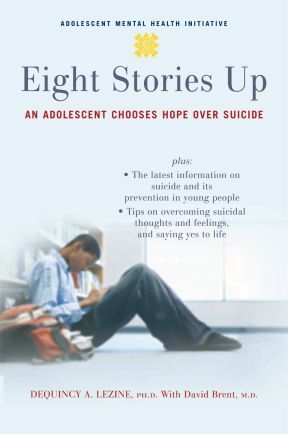
Eight Stories Up: An Adolescent Chooses Hope Over Suicide

Bibliographic Information: Lezine, D. A. & Brent, D.  (2008).  Eight stories up: An adolescent chooses hope over suicide. Oxford: Oxford University Press.
ISBN:  978-0-19-532557-7


Plot Summary: DeQuincy A. Lezine, Ph. D, was once plagued by thoughts of suicide and depression as a young adult. After several failed attempts to end his life, Lezine was able to find the help he needed to diagnose the root of his troubles and to finally make the right changes. After building a life in suicide prevention, Lezine decided to write this book for teens who may be struggling with the same problems he once faced. Lezine writes this book with a simple and direct narrative and truly attempts to reach out to his main audience of young adults and teens. Lezine breaks this book down into six distinct parts that describe each level of his journey:
Letter to the Reader in Crisis, The Background Story (where and why it began), Inside the Suicidal Mind (understanding what is happening), Getting Help, Recovery, and Finding the Phoenix: Where I Am Today. Lezine also provides a frequently asked questions section, a glossary of relevant terms, and a resource section full off important suicide prevention services and hotlines. Lezine has crafted this book as an open and sincere suicide prevention resource that teens can rely on when they have nowhere else to turn. 

Critical Evaluation: Lezine draws from his own experience to reach across and help a new generation of young adults who are struggling with the same paralyzing and destructive disorder that once plagued his own life. His opening "Letter to the Reader in Crisis" reiterates the fact that suicide is one single choice amongst many in terms of how to deal with the pain of depression. Lezine believes, that like any other big decision, that suicide always deserves a second opinion. For this reason, Lezine believes that it is important to not make brash decisions when under great pain and to always reach out, whether it be to a friend, a mentor, or even to a national suicide prevention hotline (like National Suicide Prevention Hotline 1-800-273-TALK [8255]). The overall message Lezine wants to impart is this: you owe it to yourself to examine every option before deciding on something as permanent and irreversible as suicide.


Reader’s Annotation:
Suicide is a silent killer that must be studied and discussed in order to be stopped. Suicide is not the only option. 
 
Information About the Author: DeQuincy Lezine, Ph. D was inspired to write this work due to his own brush with suicide freshman year of college (dmh.mo.gov, 2012). Lezine was fortunate to survive three separate suicide attempts and receive the help he needed to move on. He then began the first Suicide Prevention Action network at Brown University (BSPAN) (dmh.mo.gov, 2012).  Lezine has been a very active advocate of suicide prevention since then (dmh.mo.gov, 2012).

Lezine completed his doctoral training in clinical psychology from UCLA and a postdoctoral fellowship at the University of Rochester (dmh.mo.gov, 2012). Lezine's research emphasis has been on suicide prevention and continues to advocate for the survivors of suicide through a variety of different suicide prevention techniques (dmh.mo.gov, 2012).

Genre:
Nonfiction

 
Subgenre: Suicide Prevention
 
Curriculum Ties: Can tie into a health lesson on suicide prevention and detection.

Booktalking Ideas:

1). How can suicide prevention resources be presented to teens in a non-threatening and helpful manner?
2). How many suicide prevention resources are you familiar with?
3). What suicide prevention resources are offered at your school or work place?

Reading Level/Interest Age: YA

Challenge Issues: Discusses suicide and its effects in detail. I would used the following items to defend this book if it was ever challenged:

1) Refer to Library Bill of Rights, see items: I, II, and III (http://www.ala.org/advocacy/intfreedom/librarybill).
2) Refer to San Diego Public Library collection policy - (http://www.sandiego.gov/public-library/about-the-library/freedom.shtml).  Original site: The American Library Association (ALA) Freedom to Read/View Statement (http://www.ala.org/offices/oif/statementspols/ftrstatement/freedomreadstatement).
3) Refer to California School Library Association (CSLA), Model School Library Standards - September 2010 (http://www.csla.net/index.php/publications/school-library-standards). PDF: (http://www.cde.ca.gov/be/st/ss/documents/librarystandards.pdf).
4) Refer t0 American Association for School, Librarians Standards for the 21st Century Learner (http://www.ala.org/aasl/sites/ala.org.aasl/files/content/guidelinesandstandards/learningstandards/AASL_Learning_Standards_2007.pdf)
5) Contact Office of Intellectual Freedom for any further support, 800-545-2433, ext. 4223 or oif@ala.org.
6) Refer to legitimate book reviews, such as: School Library Journal, Booklist, Kirkus Reviews, Horn Book and others; found on either Academic Search Premier, Follett's TITLEWAVE, or Amazon.com.

Why did you include this book in the titles you selected?:
Suicide is a very serious aspect of teen life that must be discussed and attacked head on in order for it to be stopped. Lezine writes a very sincere book on his own experiences that offer teens a safe haven where they can closely study someone else's experience as well as their own. This book is important in helping teens understand and overcome suicidal tendencies or tragedies.

Reference Page:


dmh.mo.gov.  (2012).   2010 suicide prevention conference: Featured speakers.  Retrieved August 5, 2012 from http://dmh.mo.gov/mentalillness/suicide/conference/2010/index.htm

Saturday, August 4, 2012

AlternaCrafts: 20+ Hi-Style Lo-Budget Projects to Make

Bibliographic Information: Vitkus, J.  (2005).  AlternaCrafts: 20+ Hi-style lo-Budget projects to make.  New York : Stewart, Tabori & Chang.
ISBN: 978-1-58479-465-1

Plot Summary: AlternaCrafts: 20+ Hi-Style Lo-Budget Projects to Make offers independently minded teens fun and new exciting craft ideas that they can complete with items they already own. This book will teach teens how to transform old items (unused jeans, tshirts, bottle caps, etc.) into fun new items that are ready for every day wear and use (jean skirt, tshirt run, bottle cap pendants and magnets etc.). The book is broken down into items to wear, items to make for the home, and gifts. Teens will be attracted by the bright pictures and simplified tutorials with plenty of explanations and definitions.

Critical Evaluation: N/A

Reader’s Annotation:
Time to get crafty with these fun modern craft ideas.

Information About the Author: Jessica Vitkus received her B.A in English from Columbia University in 1988 (linkedin.com, 2012). She currently works for Animal Planet. She has previously worked on OWN (Oprah Winfrey Network), MTV (a variety of shows), "Who Wants to be a Millionaire?," The Daily Show, Martha Stewart, and many others (linkedin.com, 2012). She may have received inspiration to write AlternaCrafts: 20+ Hi-Style Lo-Budget Projects to Make after working as a magazine writer/producer/crafter with Martha Stewart Living Omnimedia.


AlternaCrafts: 20+ Hi-Style Lo-Budget Projects to Make Book Preview

Genre:
Nonfiction

Subgenre:
Arts & Crafts
 
Curriculum Ties: Could tie into a craft day or art class.

Booktalking Ideas:
N/A

Reading Level/Interest Age: YA (Follett's Titlewave, 2012)

Challenge Issues: No challenge issues.

1) Refer to Library Bill of Rights, see items: I, II, and III (http://www.ala.org/advocacy/intfreedom/librarybill).
2) Refer to San Diego Public Library collection policy - (http://www.sandiego.gov/public-library/about-the-library/freedom.shtml).  Original site: The American Library Association (ALA) Freedom to Read/View Statement (http://www.ala.org/offices/oif/statementspols/ftrstatement/freedomreadstatement).
3) Refer to California School Library Association (CSLA), Model School Library Standards - September 2010 (http://www.csla.net/index.php/publications/school-library-standards). PDF: (http://www.cde.ca.gov/be/st/ss/documents/librarystandards.pdf).
4) Refer t0 American Association for School, Librarians Standards for the 21st Century Learner (http://www.ala.org/aasl/sites/ala.org.aasl/files/content/guidelinesandstandards/learningstandards/AASL_Learning_Standards_2007.pdf)
5) Contact Office of Intellectual Freedom for any further support, 800-545-2433, ext. 4223 or oif@ala.org.
6) Refer to legitimate book reviews, such as: School Library Journal, Booklist, Kirkus Reviews, Horn Book and others; found on either Academic Search Premier, Follett's TITLEWAVE, or Amazon.com.

Why did you include this book in the titles you selected?:
I included this book because I think it is important to provide teens with an outlet for artistic expression. Many teens are participating in DIY and crafting projects recently due to the great success of the social media site, Pinterest.

Reference Page:


Follett's Titlewave.  (2012).   AlternaCrafts: 20+ hi-style lo-budget projects to make.  Retrieved August 4, 2012 from Follett's Titlewave App. 

 
linkedin.com.  (2012).  Jessica Vitkus.  Retrieved August 4, 2012 from http://www.linkedin.com/pub/jessica-vitkus/5/ba/4a9

Where's My Stuff?: The Ultimate Teen Organizing Guide

Bibliographic Information: Moss S., Schwartz, L. & Wertz, M.  (2007). Where's my stuff?: The ultimate teen organizing guide. San Francisco: Zest Books.
ISBN: 978-0-9819733-7-1

Plot Summary: Teens live active lives that require a lot of careful planning or organization or else things can fall apart. Moss, Schwartz, and Wertz have written this book for all the teens that may need a little extra help figuring out how to get things together. This book starts off by explaining why being organized is important, then provides a quiz so that the reader can determine what kind of organizational help they need, and make the following sections more useful. This organizational guide includes sections on how to organize school stuff, the room, activities and time, and even provides visual examples of how to organize each item. All these chapters are geared towards making life easier for busy teens. Even parents can benefit from some of the tips and suggestions that are offered throughout the chapters of this book.

Critical Evaluation: N/A

Reader’s Annotation:
Being organized means more time for fun, relaxation, and getting the right stuff done!
 
Information About the Author: Samantha Moss has participated in many projects over the last ten years as both writer and editor (Moss, 2012). Some of her projects include: Pottery Barn Flowers and ten volumes of the Pottery Barn Design Library (Moss, 2012). She currently lives in Oakland, California with her husband, Boyd, and their dog, Belly (Moss, 2012). 

Lesley Schwartz graduated from both Wellesley College and Mills College and currently lives in San Francisco, California
(Schwartz, 2007). Schwartz has a variety of professional skills: including teen organizer, academic coach, and tutor (Schwartz, 2007). She has also worked as a teacher in the past (Schwartz, 2007). Schwartz was the primary consultant for Where's My Stuff?: The Ultimate Teen Organizing Guide (Schwartz, 2007).
 
Michael Wertz is a commercial artist that has been contracted on a number of jobs (Wertz, 2012). Wertz designs art pieces that begin as pencil drawings and end as bold digital collages, mono prints, and screen prints (Wertz, 2012). Wertz has had projects with over 35 large organizations, such as: Pottery Barn, Scholastic Inc., Cisco, Hewlett-Packard, and many more (Wertz, 2012). Wertz does work for all age ranges and isn't solely dedicated to children's projects (Wertz, 2012).

Genre:
Nonfiction

 
Subgenre:
Personal Organization
 
Curriculum Ties: Could tie into a lesson on personal time and space management.

Booktalking Ideas:
N/A

Reading Level/Interest Age: YA (Follett's Titlewave, 2012)

Challenge Issues: No challenge issues.

1) Refer to Library Bill of Rights, see items: I, II, and III (http://www.ala.org/advocacy/intfreedom/librarybill).
2) Refer to San Diego Public Library collection policy - (http://www.sandiego.gov/public-library/about-the-library/freedom.shtml).  Original site: The American Library Association (ALA) Freedom to Read/View Statement (http://www.ala.org/offices/oif/statementspols/ftrstatement/freedomreadstatement).
3) Refer to California School Library Association (CSLA), Model School Library Standards - September 2010 (http://www.csla.net/index.php/publications/school-library-standards). PDF: (http://www.cde.ca.gov/be/st/ss/documents/librarystandards.pdf).
4) Refer t0 American Association for School, Librarians Standards for the 21st Century Learner (http://www.ala.org/aasl/sites/ala.org.aasl/files/content/guidelinesandstandards/learningstandards/AASL_Learning_Standards_2007.pdf)
5) Contact Office of Intellectual Freedom for any further support, 800-545-2433, ext. 4223 or oif@ala.org.
6) Refer to legitimate book reviews, such as: School Library Journal, Booklist, Kirkus Reviews, Horn Book and others; found on either Academic Search Premier, Follett's TITLEWAVE, or Amazon.com.

Why did you include this book in the titles you selected?:
As teens become older they will be expected to be able to manage their own lives. Often teens cannot live up to this expectation because they are not equipped with the right skills. I included this book in my collection because I believe being organized and on time is key in anyone's success. This book will help teens develop the skills they need to stay on top of their hectic schedules.

Reference Page:

Follett's Titlewave.  (2012).  Where's my stuff?: The ultimate teen organizing guide. Retrieved August 4, 2012 from Follett's Titlewave App.

Moss
, S.  (2012).  Bio. Retrieved August 4, 2012 from http://samanthamoss.com/bio.html

Schwartz, L.  (2007).  Biography.  Retrieved August 4, 2012 from http://www.lesleyschwartz.com/bio.html

Wertz, M.  (2012).  About.  Retrieved August 4, 2012 from http://wertzateria.com/about.html


cover art: http://technorati.com/lifestyle/family/article/teenlit-wheres-my-stuff-is-a/

The Official SAT Study Guide, Second Edition

Bibliographic Information: The College Board.  (2009).  The official SAT study guide, second edition.  New York: CollegeBoard
ISBN: 978-087-447-852-5

Plot Summary: This updated study guide is jam packed with tips and tricks for any student to improve their overall SAT score. This study guide is broken down into five sections that are each dedicated to analyzing one particular part of the SAT exam. Part I features an introduction and description of the SAT's. Part II includes a close look at the critical reading section of the SAT's and focuses on passage-based reading. Part III studies the writing section of the SAT's and reviews the mechanics of proper writing. Part IV is a mathematics section and includes a review on subjects like: numbers and operations, algebra, and several others. The final section Part V, offers ten full practice tests with answer keys that put the already learned lessons, tips, and tricks into play. 

Critical Evaluation: N/A

Reader’s Annotation:
SAT study guides: essential for any high school student's future success!
 
Information About the Publisher: The College Board was originally formed by 12 colleges and universities in 1900 as a way to standardize the process of students being tested and applying to different universities (collegeboard.org, 2012). The College Board was eventually replaced by the SAT's and has been reviewed and reformatted since its inception (collegeboard.org, 2012). Currently CollegeBoard works hard to provide services to children in K-12 all geared towards making the path to college easier (collegeboard.org, 2012).

CollegeBoard interacts with over seven million students and parents, in a 180 countries and territories, and through over 900 colleges and universities
(collegeboard.org, 2012). CollegeBoard believes in making college possible through financial, academic, and mentorship support (collegeboard.org, 2012).

Genre: 
Nonfiction

Subgenre:
Study Guide
 
Curriculum Ties: Could tie into SAT prep courses offered in school.

Booktalking Ideas:
N/A

Reading Level/Interest Age: YA (Follett's Titlewave, 2012)

Challenge Issues: No challenge issues

1) Refer to Library Bill of Rights, see items: I, II, and III (http://www.ala.org/advocacy/intfreedom/librarybill).
2) Refer to San Diego Public Library collection policy - (http://www.sandiego.gov/public-library/about-the-library/freedom.shtml).  Original site: The American Library Association (ALA) Freedom to Read/View Statement (http://www.ala.org/offices/oif/statementspols/ftrstatement/freedomreadstatement).
3) Refer to California School Library Association (CSLA), Model School Library Standards - September 2010 (http://www.csla.net/index.php/publications/school-library-standards). PDF: (http://www.cde.ca.gov/be/st/ss/documents/librarystandards.pdf).
4) Refer t0 American Association for School, Librarians Standards for the 21st Century Learner (http://www.ala.org/aasl/sites/ala.org.aasl/files/content/guidelinesandstandards/learningstandards/AASL_Learning_Standards_2007.pdf)
5) Contact Office of Intellectual Freedom for any further support, 800-545-2433, ext. 4223 or oif@ala.org.
6) Refer to legitimate book reviews, such as: School Library Journal, Booklist, Kirkus Reviews, Horn Book and others; found on either Academic Search Premier, Follett's TITLEWAVE, or Amazon.com.

Why did you include this book in the titles you selected?:
I selected this book for the older segment of my age group (17-18, possibly 16). These students are working hard to graduate and will understand the impact of a great score on future plans. Providing study guides for students is a great way to ensure they will succeed.

Reference Page:

collegeboard.org.  (2012).  About us.  Retrieved August 4, 2012 from http://about.collegeboard.org/  

Follett's Titlewave.  (2012).  The official SAT study guide, second edition.  Retrieved August 4, 2012 from Follett's Titlewave App.

 cover art: http://freeebooksearch.net/the-official-sat-study-guide-2nd-edition

Friday, August 3, 2012

Seizure

Bibliographic Information: Reichs, K. Seizure.  (2011).  New York: Razorbill. ISBN: 978-1-59514-394-5 

Plot Summary: In this second installment of the "Virals Series," Tory Brennan's pack, "the virals" is in danger of being disbanded if a solution is not found in the very near future. Tory and her fellow friends, learn that the institution that their parents work in may be shut down which would force "the pack" to be separated. In a stroke of desperation, Tory decides to seek out the mythical treasure of Anne Bonny, a historical female pirate; in order to save their parents' jobs. Tory and her gang set out on several adventures that involve breaking and entering, theft, dealing with questionable characters, and a jail break. They soon find that they may not be the only ones hunting down the coveted lost treasure and find that they must watch their every step.

Critical Evaluation: The theme of "the wolf pack" is further developed in this novel. The virals (Tory, Hi, Shelton, and Ben) must learn to develop their pack strengths as they are continually tested by a number of factors. Reichs also defines the role of each "viral" as she shows Tory also realizing that she has unconsciously been given the role as the "alpha." Tory takes this knowledge and works hard throughout the novel to motivate her "pack" to work together in order to save the institution their parents work in. The pack realizes that if the institution is shut down then that they will be forced to move away from each other. This knowledge lends a sense of urgency to everything the "virals" do from that point out; a factor that helps to further strengthen their relationship. Reichs makes a point of giving the characters the ability to mentally connect (under great amounts of stress and panic) in order to demonstrate how deep their ties run. This "wolf pack" will only continue to improve as they are challenged by great obstacles that they must solve together.

 
Reader’s Annotation:
Buried treasure does not stay buried forever and may come at a high cost.
 
Information About the Author: Kathy Reichs, originally Kathleen Joan Tolle, was born on July 7, 1948 in Chicago, Illinois (notablebiographies.com, 2012). She grew up in a religious Catholic family and spent most of her time within her own neighborhood (notablebiographies.com, 2012). Reichs married at the young age of 19 to Paul Reichs, an attorney and Marine captain (notablebiographies.com, 2012). Reichs then attended American University for her undergraduate studies (anthropology) and Northwestern for her PhD (skeletal biology) (notablebiographies.com, 2012). Reichs  then accepted a teaching position at the University of North Carolina at Charlotte (notablebiographies.com, 2012). Reichs' career as a forensic anthropologist inspired her novels (being an author is her second career) (notablebiographies.com, 2012). Her novels have been inspired by details of her many cases (notablebiographies.com, 2012).  Reichs now splits her times between North Carolina and Quebec, Montreal (notablebiographies.com, 2012). She has worked with a variety of government agencies (including the FBI) and is highly sought after for her expertise (notablebiographies.com, 2012). 

The "Virals Series" is Reichs' first forage into the YA scene. She has received great reviews and plans to continue the series. Some of Reichs' other works:  Deja Dead (1997), I'd Kill for That (2005), Death du Jour (1999), Deadly Decisions (2000), No Rest for the Dead (2011), and many, many others (Reichs, 2012). Reichs has released about one novel every year since 1997 (notablebiographies.com, 2012).

Genre:
Science Fiction, Mystery, Horror, and Suspense, Adventure


Subgenre:
Paranormal Powers, Exploration
 
Curriculum Ties: N/A

Booktalking Ideas:

1). What is important about Tory's relationship with Coop? 
2). How does Tory become the alpha "viral?"

Reading Level/Interest Age:  Lexile Reading Level: 480/ YA (Follett's Titlewave, 2012)

Challenge Issues: Does include some violence and strong language. I would use the following items to defend this book if it was ever challenged:

1) Refer to Library Bill of Rights, see items: I, II, and III (http://www.ala.org/advocacy/intfreedom/librarybill).
2) Refer to San Diego Public Library collection policy - (http://www.sandiego.gov/public-library/about-the-library/freedom.shtml).  Original site: The American Library Association (ALA) Freedom to Read/View Statement (http://www.ala.org/offices/oif/statementspols/ftrstatement/freedomreadstatement).
3) Refer to California School Library Association (CSLA), Model School Library Standards - September 2010 (http://www.csla.net/index.php/publications/school-library-standards). PDF: (http://www.cde.ca.gov/be/st/ss/documents/librarystandards.pdf).
4) Refer t0 American Association for School, Librarians Standards for the 21st Century Learner (http://www.ala.org/aasl/sites/ala.org.aasl/files/content/guidelinesandstandards/learningstandards/AASL_Learning_Standards_2007.pdf)
5) Contact Office of Intellectual Freedom for any further support, 800-545-2433, ext. 4223 or oif@ala.org.
6) Refer to legitimate book reviews, such as: School Library Journal, Booklist, Kirkus Reviews, Horn Book and others; found on either Academic Search Premier, Follett's TITLEWAVE, or Amazon.com.

Why did you include this book in the titles you selected?:
This book is an action packed adventure, mystery, suspense, and horror and science fiction book. It is a great addition to my collection and will be sure to attract reluctant readers who may want some suspense to keep reading interesting.

Reference Page:


Follett's Titlewave.  2012.  Virals.  Retrieved August 3, 2012 from Follett's Titlewave iPhone App. 


notablebiographies.com.  (2012).  Kathy Reichs biography.  Retrieved August 3, 2012 from  http://www.notablebiographies.com/newsmakers2/2007-Pu-Z/Reichs-Kathleen-J.html


Reichs, K.  (2012).  Books.  Retrieved August 3, 2012 from http://kathyreichs.com/category/books-by-kathy-reichs/ 

 
cover art: http://serious-insanity.blogspot.com/2012/03/book-review-seizure-virals-2-by-kathy.html

Virals

Bibliographic Information: Reichs, K.  (2010).  Virals.  New York: Razorbill.
ISBN: 978-1-59514-342-6 

Plot Summary: Due to the loss of her mother, Tory Brennan has recently moved in with her father, Kit Howard, who she has never met before. Tory's father lives on a secluded island off of the coast of Charleston, South Carolina. It isn't long before she has made friends with three other boys (Ben, Hi, and Shelton) who also live on the secluded island. Before they know it, Tory and her friends are running through the island discovering all its crooks and crannies. Tory and her gang stumble upon an old dog tag and skeleton and vow to break into the institute to find out who the person was. In the process, Tory and her gang run into a secret testing lab where they find a wolf-dog pup and decide to set it free. Their decision sets off a strange series of events in which the gang falls sick and starts noticing strange, supernatural changes. The adventure only begins there when the gang realizes they must use their newly found powers to solve a years old murder and mystery. The powers, though, may not be enough to keep Tory and her friends safe!

Tory Brennan, the niece of the forensic anthropologist Temperance Brennan, is no stranger to adventure and rises to lead her group of friends through danger and adventure.

Critical Evaluation: Reichs chooses to connect her new YA character to her widely known character, Temperance Brennan. This sets the setting for the Virals series and directly influences Tory as a character. Although Tory has recently learned that she is related to Temperance Brennan, she still shares many of the same characteristics with her aunt- they are both brilliant, straight talking, no fuss characters. Reichs choice to do this builds almost a bridge between her two different realities and expands her characters' universes. This also helps to explain why Tory, a young 14 year old, is able to handle all her different adventures and mysteries since she is related to such an adventurous and intelligent aunt. This extension of Reichs' universe gives a more complex depth to Tory's story and also sets the bar of what to expect from both Tory and her storyline. Some may also argue that connecting the two realities from her big selling Temperance Brennan with her new Tory Brennan series really limits and predetermines the plot of the Virals series.

Reader’s Annotation:
Being in the wrong place at the wrong time changes everything for Tory and her friends
 
Information About the Author: Kathy Reichs, originally Kathleen Joan Tolle, was born on July 7, 1948 in Chicago, Illinois (notablebiographies.com, 2012). She grew up in a religious Catholic family and spent most of her time within her own neighborhood (notablebiographies.com, 2012). Reichs married at the young age of 19 to Paul Reichs, an attorney and Marine captain (notablebiographies.com, 2012). Reichs then attended American University for her undergraduate studies (anthropology) and Northwestern for her PhD (skeletal biology) (notablebiographies.com, 2012). Reichs  then accepted a teaching position at the University of North Carolina at Charlotte (notablebiographies.com, 2012). Reichs' career as a forensic anthropologist inspired her novels (being an author is her second career) (notablebiographies.com, 2012). Her novels have been inspired by details of her many cases (notablebiographies.com, 2012).  Reichs now splits her times between North Carolina and Quebec, Montreal (notablebiographies.com, 2012). She has worked with a variety of government agencies (including the FBI) and is highly sought after for her expertise (notablebiographies.com, 2012).

The "Virals Series" is Reichs' first forage into the YA scene. She has received great reviews and plans to continue the series. Some of Reichs' other works: 
Deja Dead (1997), I'd Kill for That (2005), Death du Jour (1999), Deadly Decisions (2000), No Rest for the Dead (2011), and many, many others (Reichs, 2012). Reichs has released about one novel every year since 1997 (notablebiographies.com, 2012). 


Interview with Kathy Reichs

Genre:
Science Fiction, Mystery, Horror, and Suspense, Adventure

Subgenre:
Biological Experiments, Paranormal Powers
 
Curriculum Ties: N/A

Booktalking Ideas:
 

1). What transformations have Tory and her friends experienced?
2). Was it right for them to take Coop?

Reading Level/Interest Age: Lexile Reading Level/YA (Follett's Titlewave, 2012)

Challenge Issues: Some themes of violence, murder, and recklessness. I would use the following items to defend this book if it was ever challenged:

1) Refer to Library Bill of Rights, see items: I, II, and III (http://www.ala.org/advocacy/intfreedom/librarybill).
2) Refer to San Diego Public Library collection policy - (http://www.sandiego.gov/public-library/about-the-library/freedom.shtml).  Original site: The American Library Association (ALA) Freedom to Read/View Statement (http://www.ala.org/offices/oif/statementspols/ftrstatement/freedomreadstatement).
3) Refer to California School Library Association (CSLA), Model School Library Standards - September 2010 (http://www.csla.net/index.php/publications/school-library-standards). PDF: (http://www.cde.ca.gov/be/st/ss/documents/librarystandards.pdf).
4) Refer t0 American Association for School, Librarians Standards for the 21st Century Learner (http://www.ala.org/aasl/sites/ala.org.aasl/files/content/guidelinesandstandards/learningstandards/AASL_Learning_Standards_2007.pdf)
5) Contact Office of Intellectual Freedom for any further support, 800-545-2433, ext. 4223 or oif@ala.org.
6) Refer to legitimate book reviews, such as: School Library Journal, Booklist, Kirkus Reviews, Horn Book and others; found on either Academic Search Premier, Follett's TITLEWAVE, or Amazon.com.

Why did you include this book in the titles you selected?:
Virals is the first novel in the Virals series and begins the story of Tory Brennan, the young niece sleuth of the famed forensic anthropologist, Temperance Brennan. This book will attract mystery lovers and keep young readers hooked as they work to solve the mystery.

Reference Page:


Follett's Titlewave.  (2012).  Virals.  Retrieved August 3, 2012 from Follett's Titlewave App.

notablebiographies.com.  (2012).  Kathy Reichs biography.  Retrieved August 3, 2012 from  http://www.notablebiographies.com/newsmakers2/2007-Pu-Z/Reichs-Kathleen-J.html

Reichs, K.  (2012).  Books.  Retrieved August 3, 2012 from http://kathyreichs.com/category/books-by-kathy-reichs/ 
 
cover art: http://fine-nelsogno.blogspot.com/2011/04/virals-di-kathy-reichs.html

Thursday, August 2, 2012

New Moon

Bibliographic Information: Meyer, S.  (2006).  New moon. New York: Little, Brown, and Company.
ISBN: 978-0316075657

Plot Summary: Bella is finally with her one true love, Edward. The Cullen's decide to throw Bella an 18th birthday party as a way to welcome her to the family and to acknowledge  her relationship with Edward. In the process of opening a gift, Bella accidentally gets a paper cut. This sets off a chain of events in which Edward is forced to protect her from getting attacked from a suddenly blood thirsty Jasper. Fearing for Bella's life, Edward shuns Bella and moves away with the entire Cullen family as a way to protect her. This leaves Bella in an intense state of catatonia and suicidal. Through a series of misunderstandings and miscommunications Edward comes to believe that Bella is dead and vows to end his existence. Bella must race against time in order to save the vampire she loves.


Critical Evaluation: New Moon pulled much inspiration from William Shakespeare's, Romeo and Juliet. Stephanie Meyer creates a parallel story between her tale and that of Shakespeare's. Edward and Bella come from two different "houses," or worlds, that do not believe they should be together. Bella and Edward, much like Romeo and Juliet, ignore their families and proceed to fall further in love. Both stories then experience game changing difficulties (Romeo killing Juliet's cousin, Bella slicing her finger and exposing Jasper to her blood) which force the young lovers to be apart. Then through several misunderstandings both male characters, Romeo and Edward, come to believe that their beloveds have passed away in their absences. Both characters then decide to take their grief into their hands and end their suffering by committing some form of suicide. This, though, is where both stories diverge. The classic Romeo and Juliet ends in tragedy, whereas Bella and Edward's story ends with an uplifting role reversal and solution. This choice to diverge from the classic tragedy not only gives the book more ample space to explore its own identity but also allows the story to continue on.

Reader’s Annotation:
Bella must look beyond her depression to save the one she loves.
 
Information About the Author: Stephenie Meyer, born Stephenie Morgan, was born on December 24, 1973 to a Mormon family in Hartford, Connecticut (biography.com, 2012).  Her family then relocated to Phoenix, Arizona where she grew up (biography.com, 2012). Being the eldest of six siblings, Meyer helped her parents with her younger brothers and sisters (biography.com, 2012). Meyer received a National Merit Scholarship and attended Brigham University to study English literature (biography.com, 2012). She reconnected with an old friend who she married a year after reconnecting (biography.com, 2012). After graduating, Meyer chose to be a stay at home mom to three boys (biography.com, 2012).

Meyer states that she got the inspiration to write Twilight from a very vivid dream she had which she shortly after converted into an outline and then a 500 page manuscript (Meyer, 2012). Meyer has also written: New Moon, Eclipse, and her adult novel, Host.


Genre:
Romance, Adventure, Fantasy 

Subgenre:
Paranormal Romance, Vampires
 
Curriculum Ties: Can be used to discuss teen love, the vampire myth, and coping skills.

Booktalking Ideas:

1). Are teens capable of experiencing true love?
2). Does this book emulate aspects of Shakespeare's, Romeo and Juliet? 

Reading Level/Interest Age: YA/ Lexile Reading Level: 690 (Follett's Titlewave, 2012). Grades 9 & up (Follett Titlewave
(School Library Journal), 2012). 

Challenge Issues: This book features vampires, violence, and suicidal tendencies. I would use the following items to defend this book if it was challenged:

1) Refer to Library Bill of Rights, see items: I, II, and III (http://www.ala.org/advocacy/intfreedom/librarybill).
2) Refer to San Diego Public Library collection policy - (http://www.sandiego.gov/public-library/about-the-library/freedom.shtml).  Original site: The American Library Association (ALA) Freedom to Read/View Statement (http://www.ala.org/offices/oif/statementspols/ftrstatement/freedomreadstatement).
3) Refer to California School Library Association (CSLA), Model School Library Standards - September 2010 (http://www.csla.net/index.php/publications/school-library-standards). PDF: (http://www.cde.ca.gov/be/st/ss/documents/librarystandards.pdf).
4) Refer t0 American Association for School, Librarians Standards for the 21st Century Learner (http://www.ala.org/aasl/sites/ala.org.aasl/files/content/guidelinesandstandards/learningstandards/AASL_Learning_Standards_2007.pdf)
5) Contact Office of Intellectual Freedom for any further support, 800-545-2433, ext. 4223 or oif@ala.org.
6) Refer to legitimate book reviews, such as: School Library Journal, Booklist, Kirkus Reviews, Horn Book and others; found on either Academic Search Premier, Follett's TITLEWAVE, or Amazon.com.

Why did you include this book in the titles you selected?:
This is the second book of the popular Twilight series. Teens will enjoy reading the continuation of Bella Swan's story. This book also contains the popular subgenre of vampires.

Reference Page:
 

biography.com.  (2012).  Stephenie Meyer biography.  Retrieved August 2, 2012 from http://www.biography.com/people/stephenie-meyer-456668?page=1

Follett's Titlewave.  (2012). New Moon.  Retrieved August 2, 2012 from Follett's Titlewave app. 


Follett's Titlewave.  (2012). New Moon (School Library Journal).  Retrieved August 2, 2012 from Follett Titlewave app.


Meyer, S.  (2012). Bio. Retrieved August 2, 2012 from http://www.stepheniemeyer.com/bio.html

cover art: http://www.stepheniemeyer.com/newmoon.html